Solutions to Activity 6
The problems you should study for the final exam are marked with a (***).
(***) 1. Classify each of the following statements as an example of theoretical probability, relative frequency interpretation of probability, or personal (subjective) probability.
a. On the basis of prior counts, a quality control engineer says that there
is a 0.005 probability that a vacuum hose is defective.
Because of the phrase "on the basis of prior counts," the
sentence suggests that the relative frequency of failures in the past has been
determined, and that the relative frequency is basis for the probability
statement.
b. The probability that I will get the flu this winter is 30%.
This sentence, due to it unrepeatability and specificity
to a particular person and place, is an example of subjective probability.
c. The probability of selecting five card of the same suit (a flush) from a standard deck of cards is 0.00005.
This sentence is an example of theoretical probability where one assumes that all possible hands of cards from the deck are equally likely.
d. The chance that a randomly selected person in the United States is between 15 and 24 years old is 0.14.
This sentence is based on census counts and therefore is an example of the relative frequency interpretation of probability.
e. The probability that General Electric's stock price will rise today is 75%.
This sentence exemplifies the subjective feeling about the likelihood of GE's stock rising on a particular day. Note there is no way to repeat this experiment. Each day is so different.
(***)2. a. Describe the sample space (set of possible outcomes) for the experiment
of tossing three coins.
{HHH, HHT, HTH, HTT, THH, THT, TTH,
TTT}
b. Using the sample space, calculate the theoretical probability that you get 2 heads and
1 tail.
3 out of 8 possible outcomes listed in part a have 2
heads and 1 tail, so the probability is 3/8 or 0.375.
c. What the probability of getting three heads?
1 out of 8 or 0.125.
d. What is the probability of getting at least one tail?
You can count (seven out of the eight possibilities have at least one tail) or you can note that this event is complementary to the event of getting three heads, so the probability is 1 – 0.125 = 0.875.
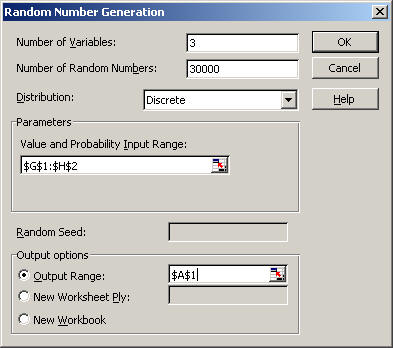
(skip) e. Use Excel to simulate question b with 30000 trials. Out of how many trials do you get 2 heads and 1 tail? How close is the relative frequency of the event in the 30000 trials to the theoretical probability? (Hint. Simulate 3 columns of data, using 1 for heads and 0 for tail. Then in column D add up each row (use =SUM(...) or =A1 +B1+ C1). The sum will be how many heads you get. Finally use COUNTIF on column D.)
I got 11230 out 30000 which is
relative frequency of 0.3743 which agrees quite well with the theoretical
0.375.
(skip) 3. Three people (John, Marvin, and Tom) carry similar
looking umbrellas when they arrive at restaurant. They leave the umbrellas
in small coat room in the restaurant, and when each leaves, he randomly takes
one of the three similar looking umbrellas.
a. Describe the sample space (the set of possible outcomes) for this experiment.
Let us say that John has umbrella 1, Marvin has umbrella 2, and Tom has umbrella 3. Then there are six possibilities:
{ (J1,M2,T3), (J1,M3,T2), (J2, M1,T3), (J2,M3,T1), (J3,M1,T2), (J3,M2,T1) }
b. Using the sample space, calculate the probability that
all three people end up with an umbrella that is not their own.
Two of the six possibilities are such that all three
people end up with an umbrella that is not their own: (J2,M3,T1) and (J3,M1,T2). So
the probability is 1/3 or 0.333...
(skip) 4. Open file, Drug Test.xls. In a test of the effectiveness of an allergy drug, some people were given the drug, some were given a placebo, and a control group was given no treatment. In the empty cells, enter formulas to calculate the totals then answer the questions below.
- What is the probability that a randomly selected person in the study was given either the drug or a placebo? 220/271 ≈ 0.8118
- What is the probability that a randomly selected person either improved or did not improve?
100%- What is the probability that a randomly selected person either was given the drug or improved?
164/271 ≈ 0.6052- What is the probability that a randomly selected person was given the drug and improved?
65/271 ≈ 0.2399.
(***) 5. a. What is the probability of getting a sum of 7 on a roll of two dice?
As we discussed in class, there are 36 possible ways for the dice to fall. There are six ways of getting a 7: (1,6), (2,5), (3,4), (4,3), (5,2), (6,1). So the probability is 6/36 or 1/6 or 0.1666...
b. What is the probability of getting a 4 on a roll of two
dice?
There are only 3 ways of getting a 4: (1,3), (2,2),
(3,1); so the probability is 3/36 = 1/12 = 0.8333....
(***) 6. A small business performs a service and then bills its customers. From past experience, 90% of the customers pay their bills within two weeks.
a. What is the probability that a randomly selected customer will not pay within two weeks.
The event that a randomly selected customer will not pay within two weeks is complementary to the event of paying, so the probability is 1 – 0.9 = 0.1.b. The business has billed two customers this week. What is the probability that neither of them will pay within two weeks?
It is reasonable to assume that whether or not any individual customer does not pay within 2 weeks is independent of any other customer paying or not paying. So we can multiply the probabilities: (0.1)*(0.1) = 0.01.
(***) 7. Suppose that 10% of the students at a particular college are have a cold.
What is the probability that a student does not encounter a person with a cold until the sixth person?
0.95*0.1 ≈ 0.059.
What is the probability that one of the six people encountered in an hour has a cold?
There are six possibilities here: C N N N N N, N C N N N N, N N C N N N, N N N C N N, N N N N C N, N N N N N C. Each has the same probability of 0.95*0.1. So the probability is 6*0.95*0.1 ≈ 0.354.
If a student encounters 6 people in an hour, what is the probability that at least one of these people has a cold?
This question is similar to part b, except that, in addition to the one listed in part b, two of the six could have a cold, three of the six could have cold, etc. There are many possible cases. In situations like these it often easier to calculate the probability of the complementary event and then subtract from 1. The complementary event is the event that no one has a cold. The probability of that event is 0.96 ≈ 0.531. So the probability that at least one has a cold is 1 – 0.531 = 0.469.