
ISP 121 Assignment 5
1. Suppose two sisters are reunited after not seeing each other since one was two years old and the other was four years old. They are amazed to find out that they are both married to men named James and that they each have a daughter named Jennifer. Explain why this is not so amazing.
2. Why is not surprising that the night before a major airplane crash several people will have dreams about an airplane disaster.
3. You are at a casino with a friend, playing a game win which dice are involved. You friend has just lost six times in a row. He is convinced that he will win on the next bet because he claims, by the law of averages, it's his turn to win. He explains to you that the probability of winning this game is 40%, and because he has lost six times, he probably win the next four. Is he right? Explain briefly.
4. Suppose a friend reports that he has just had a string of "bad luck" with her car. She had three major problems in as many months and now has replaced many of the worn parts with new ones. She concludes that it is her turn to be luck and she shouldn't have any more problems for a while. Is she using the Gambler's Fallacy? Briefly explain.
5. (Simulating American Roulette) In American roulette, there are 36 numbers plus two additional one 0, and 00. All 38 possibilities are equally likely. One type of standard bet is to choose 12 numbers. You win if any one of the 12 numbers you chose comes up.
a. What is the probability of winning if you bet on 12 numbers?
b. What is the probability of losing if you bet on 12 numbers?
c. A dollar bet on 12 numbers pays $2 you win and you lose your $1 if you lose. What is the expected value of this bet?
d. Simulate this game in Excel as follows. Somewhere on the right of an Excel sheet, type
| 2 | 0.315789 |
| -1 | 0.684211 |
Then generate 30000 random trials using these values in the standard way we have been do so this quarter:
Then record in your Word document, 1) the total payout for all 30000 trials and 2) the average payout for the 30000 trials. The average payout should be close to your answer in c. (It will most likely at least within 1 cent of the theoretical.) Is it? If it isn't, you made mistake in part c!
6. A few years ago, Taco Bell had a scratch-off card promotion that contained four separate games. The player could play only one of the them and could choose which one. The probability of winning game A was 1/2, and the prize was a drink worth 55 cents. The probability of wining game B was 1/4, and the prize was a food item worth 69 cents. The probability of winning game C was 1/8, and the food prize was worth $1.44. The probability of winning game D was 1/16, and the food prize was worth $1.99.
a. Calculate the expected value of each game. (Note you didn't have to pay for the card, so the payoff if you don't win is simply 0.) Which game had the highest expected value.
b. For what reasons would people choose to play the other games even if they knew the expected values were lower?
7. (Guessing on True/False Tests)
Suppose there is a section of 10 true/false questions on a final exam. We are going to simulate what happens if you guess on all ten questions.
a. What is the probability of randomly getting any individual question correct if you guess?
b. We will first simulate what happens if you get 1 point for getting the question correct and 0 points for getting the question incorrect. Somewhere off to the right side in an Excel sheet make a table like:
| 1 | 0.5 |
| 0 | 0.5 |
Then use the Random Number Generation tool as usual with
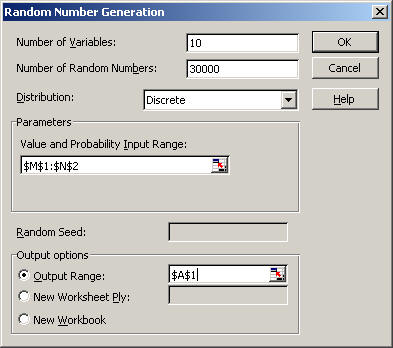
You will get 30000 rows with 10 numbers in each row. In column K, calculate score for each random set of answers (use =SUM(A1:J1 ) in K1 and fill down). Finally find the average score for the 30000 trials and record it in your Word document.
c. Suppose a student does not guess but gets 7 out of 10 correct. How does the score of this student compare to the average score when a student guesses?
d. We will now simulate what happens if you get 1 point for getting the question correct and −1 points for getting the question incorrect. This type of scoring is sometimes called "a guessing penalty." This time use the table
| 1 | 0.5 |
| −1 | 0.5 |
for your simulation. In your simulation, what is average score of someone who randomly guesses?
e. Assuming you get 1 point for getting the question correct and −1 points for getting it incorrect, what is the highest score you can get? What is the lowest score you can get?
f. Suppose a student does not guess but gets 7 out of 10 correct, answering all the questions. How does the score of this student compare to the average score when a student guesses on all the questions?
g. When using the "guessing penalty" scoring, a score of 0 is assigned if the question is left blank. Suppose a student gets 7 correct but leaves three blank. How does the score of this student compare to the average score when a student guesses on all the questions?
8. In Illinois's "Little Lotto" lottery game, you choose five numbers between 1 and 39. Five numbers are then randomly chosen and you receive a prize as given in the following table. A Little Lotto lottery ticket costs $1.
| Probability | Prize | Payout (after cost of ticket) | |
| FIRST PRIZE: Match all five numbers | 0.000001320001320 | $100,000* | $99,999 |
| SECOND PRIZE: Match four winning numbers | 0.000295246530853 | $100 | $99 |
| THIRD PRIZE: Match any three winning numbers | 0.009708737864078 | $10 | $9 |
| FOURTH PRIZE: Match any two winning numbers | 0.111111111111111 | $1 | $0 |
| Don't win anything | ? | $0 | -$1 |
* It turns out that if the first prize is not awarded on a given drawing, a portion of it is carried over to the next drawing. We are going to ignore this detail of the game. It actually makes little difference in the calculation!
a. What is the probability of not winning anything? (I.e. what is the value of the question mark in the table?)
b. Calculate the expected value of a single play of Little Lotto? (Hint: you need to use payout column.)
c. Simulate playing Little Lotto 30000 times in Excel. (To do this, make a table like
| $99,999 | 0.000001320001320 |
| $99 | 0.000295246530853 |
| $9 | 0.009708737864078 |
| $0 | 0.111111111111111 |
| -$1 | ? |
over to the side. Then as usual simulate 30000 trials.) How many times did you lose your $1? How many times was the payoff $0, $9, $99, and $99,999?
d. Little Lotto drawings occur 365 days a year. About 350,000 tickets are sold per day. Using the expected value you calculated in part b, determine the approximate income derived for the State of Illinois each year from Little Lotto.
e. According to the Illinois State Lottery, approximately 77% of the gross income from the lottery (the money not returned as prizes) goes to support public schools; about 16% goes to vendors who sell the tickets; and about 7% pays for operating expenses and advertising. Using the number you calculated in part d), calculate approximately how much of the income the Little Lotto generates each year goes in each category. (By the way, there are many other official state lottery games in Illinois, and the Little Lotto doesn't even generate one-tenth of the total income generated by the state lottery. It is a big business.)
9. a. In your own words, give some of the arguments in favor of state-run lotteries as a means of financing state government.
b. In your own words, give some of the arguments against state-run lotteries as a means of financing state government.
c. Explain why you support or oppose such lotteries.
10. What is the probability of a shared birthday in a group of 10 people?