ISP 120 - Quantitative Reasoning
Group Activity 10: Solving Exponential Equations
All group activities must include a statement signed by all members of your
group that each group member fully participated in the activity. To start you
should open a new Word document entitled something like "Group Activity 10" and
put the names of your group members at the top. Save it to the desktop and save
frequently during the hour.
Learning Goals for this Activity
- You will learn about the essential characteristics of exponential decay.
- You will learn to use logs to solve for time to reach a certain value.
- You will be able to estimate the age of artifacts given the amount of a certain
radioisotope with a known half life or decay rate.
- You will understand the basic scientific concepts that underlay radioisotope dating.
1. Revisit the populations of Russia and Nigeria from Activity 3. The
population of the Russia in 1998 was 147 million; the population of Nigeria was
106 million. Russia is decreasing in population by approximately 0.1%
annually; the population of Nigeria is growing at 3%. Using logs and
letting x be the number of years since 1998, answer the following questions.
Round both answers to the nearest tenth.
a. How long, at these rates, will it take for the
population of Nigeria to double?
b. How long, at these rates, will it take for the
population of Russia to reach 135 million?
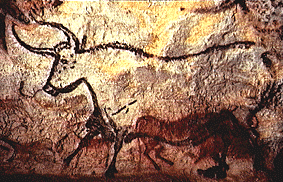
2. Some of the most famous Cro-Magnon cave paintings are located in Lascaux, France. On the right is an image from Lascaux.
Charcoal found in the cave has approximately 14% of the carbon 14 found in
living wood. Carbon 14 decays
approximately 1.202% every 100 years.
a) Make a table in Excel that has in column A years in
increments of 100 and in column B the percent of Carbon 14 remaining.
Use the table to approximate the age of the paintings. (how long
until there is only 14% of the original amount of Carbon 14 remaining?)
b) Now answer the same question using logs instead of a table.
Here you will need to define x as the number of 100 year
increments--meaning x=3 would translate to 300 years. Show your work.
|
 |
|
Age of moon |
|
|
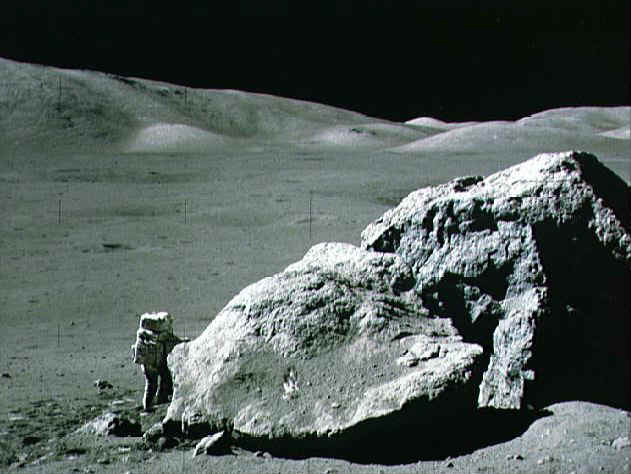
3. Rock samples brought back from the moon by Apollo astronauts have
approximately 58% of the original amount of Uranium 238 present. Uranium decays at a rate of approximately 7.41% every 500 million years.
a) Make a table in Excel that has in column A million years after
formation in increments of 500 and in column B the percent of Uranium 238
remaining. Approximate how old the rocks are
b) Now answer the same question using logs instead of a table.
You will need to define x in the formula as the number of 500
million year increments--meaning if you get x=2, that would
translate to 1000 million years. Round your answer to the
nearest million years.
Show your work
c) Use logs to find how many years since formation until there is
only 20% of the Uranium remaining. Show your work. (To check
the reasonability of your answer, use the spreadsheet you made in
question 3a).
|
 |